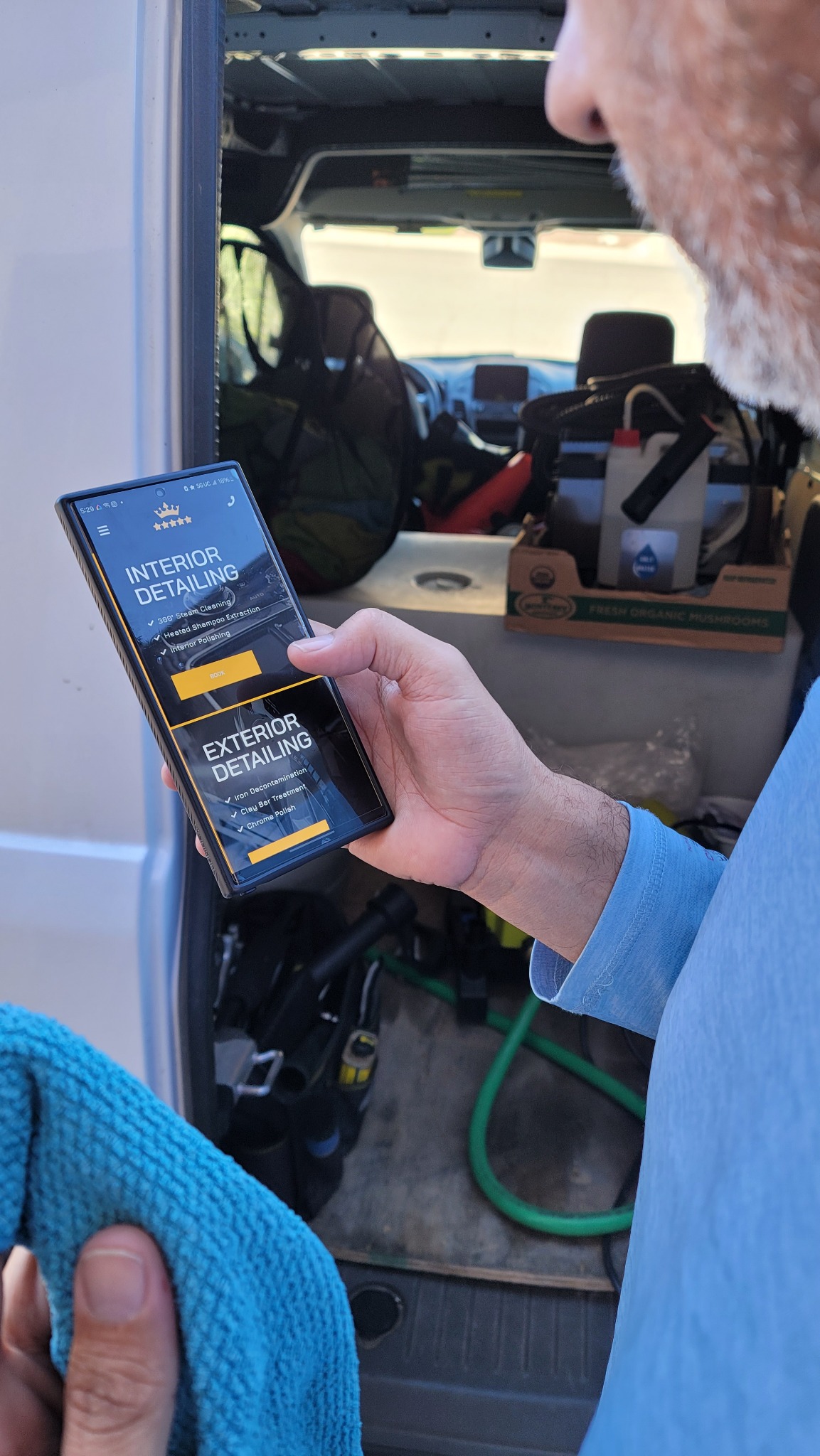
Most people who look at your website leave without booking. They weren’t saying no. They got a text, the kids needed dinner, or they wanted to check one more detailer. Retargeting is how you get back in front of them while they’re still deciding.
If you’re running ads, or thinking about it, this is the piece most detailers skip, and often the one that pays best. It works differently from regular ads, and the ads themselves need different content. This guide covers why it matters, which audiences to build, what to show them, and how to tell whether it’s working.
It builds on Advertising for mobile detailers, which covers the platforms and budgets, and our website guide, because retargeting only works if people have a good page to come back to.
What retargeting is, in plain English
Retargeting, which Google calls remarketing, shows ads to people who have already interacted with your business. [1] Someone looks at your ceramic coating page on Tuesday, leaves, and on Thursday sees your coating ad on Instagram with a review from a happy customer.
It works because the hardest part of advertising is already done. These people found you, know what you do, and showed interest. You’re no longer introducing yourself; you’re helping someone finish a decision.
The simple version. Regular ads find new people. Retargeting follows up with people who already raised their hand. A detailer who follows up books more jobs from the same traffic.
Why it matters so much for detailers
- Most visitors don’t book on the first visit. Detailing is a considered purchase, especially coatings and correction. People compare, check reviews and wait for payday.
- You already paid to get them there. Every ad click, every hour on SEO and every Instagram post that sent someone to your site cost something. Retargeting gets more out of that spend.
- The audiences are small, so the budget can be too. You’re only paying to reach a few hundred or a few thousand people who know you, not a whole city.
- It usually books at a lower cost. Warm audiences tend to convert better than strangers, which often makes retargeting the cheapest bookings in an ad plan.
- It brings customers back for the next job. Past customers are the warmest audience of all. A reminder at the right time turns a one-time detail into a maintenance customer.
Why retargeting content has to be different
This is where most detailers go wrong. They take the same ad that introduced them to strangers and show it again to people who already saw it. That ad did its job. Showing it again mostly annoys people.
Cold ads and retargeting ads answer different questions:
“Who are you, and should I care?”
- Stop the scroll with a transformation
- Show what you do and where
- Broad appeal, one simple idea
- Goal: get the first visit
“Can I trust you, and why book now?”
- Reviews, proof and real results
- Answer the objection that stopped them
- Specific to what they looked at
- A reason to book now
Someone who already visited knows your name. What they need is the push to finish: proof that you’re good, an answer to their hesitation, and a reason not to wait. That’s why retargeting content matters more per person. It’s talking to someone who is close to saying yes.
Answer the reason they left
Think about why someone looks and doesn’t book, then make an ad that answers it.
| What they’re thinking | Retargeting content that helps |
|---|---|
| “Is this person any good?” | A real review on screen with the before-and-after from that job. |
| “It’s more than I expected.” | What’s included and how long it lasts. Break a coating down to cost per month of protection. |
| “I’m not sure which package I need.” | A short video comparing two packages, or an invite to text a photo for a quote. |
| “Do they really come to me?” | Your van set up in a driveway, and the neighborhoods you serve this week. |
| “I’ll do it later.” | Limited openings this week, a seasonal reason (pollen, road salt, summer heat) or a small add-on for booking now. |
The audiences worth building
Start with a few audiences and give each one its own message. Meta keeps website visitors in an audience for up to 180 days, and Google lets you choose how long people stay in a segment. [1] Shorter windows are warmer.
- Started a booking but didn’t finish. Your hottest audience. Remind them within a few days, keep it simple, link straight back to booking.
- Viewed a specific service page. Coating viewers see coating ads; interior viewers see interior ads. Specific beats generic.
- Visited in the last 30 days. General reminder with reviews and your best offer.
- Watched most of a video or engaged on Instagram or Facebook. Warm, but less ready than website visitors. Show proof and invite them to the site.
- Past customers. Upload your customer list or use your booking history. Offer maintenance washes, seasonal protection and referral rewards.
- Booked customers (exclude them). Remove anyone who just booked from your follow-up ads so you don’t pay to sell them something they bought.
Platforms need a minimum number of people in an audience before ads can run, so small sites may need to start with a 90- or 180-day window and narrow it as traffic grows.
A simple retargeting sequence
Instead of one ad on repeat, change the message as time passes. Here’s a starting sequence for someone who visited and didn’t book:
- Days 1–3A friendly reminderShow the service they looked at and how easy it is to book.“Still thinking about that interior detail? We come to you. Pick a time in 60 seconds.”
- Days 4–14ProofReviews, before-and-afters and short videos of real jobs.“‘Looks better than when I bought it.’ Jasmine, Westside. See the full transformation.”
- Days 15–30A reason to actAn offer, limited openings or a seasonal angle.“Two openings left this week in your area. Book by Friday and we’ll add tire shine and dressing.”
- After a jobBring them backMaintenance reminders, seasonal protection and a referral offer to past customers.“It’s been 6 weeks since your detail. Keep it looking new with a maintenance wash.”
The sample quotes are illustrations to adapt. Use real reviews from your own customers, with their permission.
The retargeting you already own: texts and emails
Not all retargeting needs ad spend. If someone gave you their phone number or email, a follow-up message is the most direct reminder there is, and it’s free.
- Quote sent, no booking: a follow-up text a day or two later.
- Missed call: an instant text back with your booking link. See missed-call follow-up.
- Past customers: maintenance reminders and seasonal emails. See reminders & follow-ups and email marketing.
Only message people who agreed to hear from you, and always include a way to opt out.
Setting it up
- Install the tracking. Add the Meta Pixel and the Google tag to your website and booking page so visits and bookings are recorded. [2]
- Track the booking. Mark the booking confirmation as a conversion so you can build “started but didn’t book” audiences and exclude people who booked.
- Build three audiences first. Booking abandoners, service-page viewers and 30-day visitors.
- Make three or four ads per audience following the sequence above, and rotate them.
- Keep frequency in check. If people see the same ad too often, results drop. Refresh creative every few weeks.
- Update your privacy policy. Ad platforms require you to disclose that you use cookies and tags for advertising. [3]
On our advertising management plan, our team sets this up and runs it for you.
What could retargeting recover?
Use your own numbers. Start with the people who already visit your site and estimate how many retargeting could bring back.
Your retargeting recovery calculator
Illustrative planning tool. Defaults are examples, not expected results. Include labor, supplies, travel and fees in the cost per job.
Before fixed overhead and taxes. Fractional jobs are an average. Some of these people might have come back anyway, so treat this as an upper estimate. Repeat bookings aren’t counted.
With the example numbers, 600 visitors a month with 92% leaving gives about 552 people who didn’t book. If you can reach half of them, that’s 276 people. At 3% coming back to book, that’s about 8 jobs and $1,656 in sales on a $150 budget. This is a sample, not a forecast.
The biggest lever isn’t the budget. It’s the content: an ad that answers the right hesitation brings back far more people than one that repeats your introduction.
Where retargeting fits in your marketing
Retargeting is the middle step in a healthy ad plan: awareness brings new people, retargeting keeps you in mind, and search catches them when they’re ready. It also makes your other marketing work harder. Every visitor from SEO, social posts or a vehicle wrap becomes someone you can follow up with.
And it all depends on the page they come back to. If your booking page is slow or confusing, retargeting just brings people back to the same problem.
Rather have a team run it?
Retargeting takes setup, fresh creative and regular checks. If you’d rather spend that time on cars, we can handle it.
Start with your booking page. Create your free account, get a page people can book on, and add retargeting when you’re ready. Get started free →
Common questions
What is retargeting?
Retargeting (Google calls it remarketing) shows ads to people who already interacted with your business, like visiting your website, watching your video or booking before. Because they already know you, the ads can be more specific and usually cost less per booking than reaching strangers.
Is retargeting worth it for a small detailing business?
Usually, yes. Retargeting audiences are small, so the budget can be small too, and the people in them have already shown interest. It’s often the cheapest bookings in an ad plan once you have steady website traffic.
How many ads should someone see before it gets annoying?
Keep frequency low and the message fresh. Rotate a few different ads, cap how often each person sees them where the platform allows, and stop showing ads once someone books.
Do I need a pixel to retarget?
To retarget website visitors, yes: the Meta Pixel and Google tag record visits so the platforms can build audiences. You can also retarget people who watched your videos or engaged with your social pages, and upload a past-customer list, without website tracking.
Do I need to tell visitors I’m using retargeting?
Yes. Ad platforms require your privacy policy to explain that you use cookies or tags for advertising, and some states require more. Keep your privacy policy up to date and linked from every page.
Sources and further reading
Platform guidance checked October 18, 2026. Examples and calculators are illustrative.